
Top Attractions, Hidden Temples, and Unforgettable Experiences Inside the World’s Greatest Medieval City
Siem Reap, Cambodia – Historical & Cultural Travel – Full-Day Destination
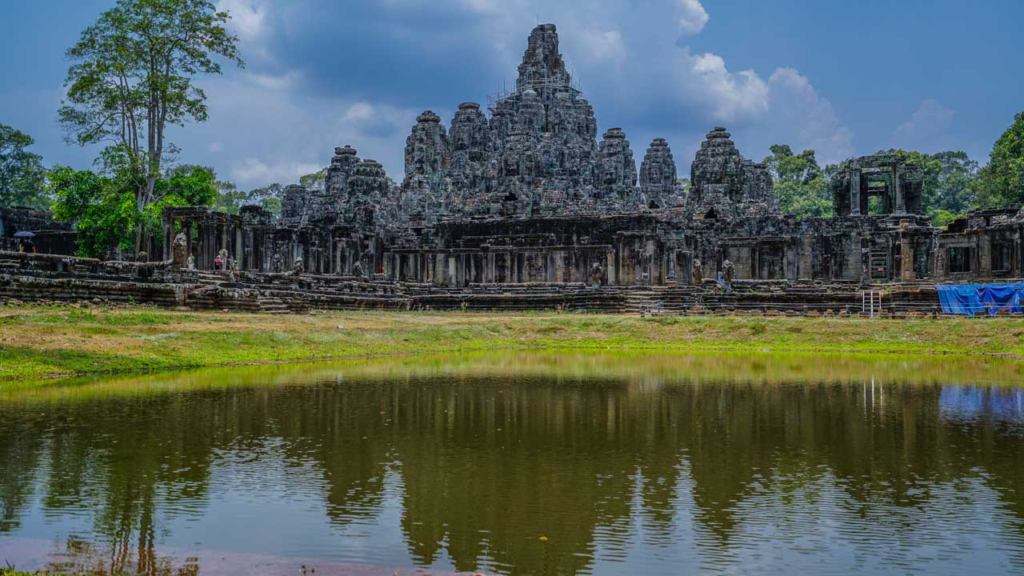
Imagine stepping through a stone gateway guarded by fifty-four colossal faces, their stone lips curled into an enigmatic half-smile that seems to know every secret the centuries have kept. Before you, a causeway stretches across a moat where stone giants grip the body of a seven-headed serpent in a cosmic tug-of-war frozen for eight hundred years. Angkor Thom — the Great City — does not merely invite you in. It absorbs you.
Few places on earth command presence the way this ancient Khmer capital does. Enclosed within a nine-kilometer wall deep in the Cambodian jungle, Angkor Thom is not a single monument but an entire civilization compressed into nine square kilometers of stone, forest, and sacred geography. Built at the height of the Khmer Empire in the late twelfth century under King Jayavarman VII, it was once home to roughly one million people — one of the largest pre-industrial cities the world had ever known.
Today, it stands as the spiritual and architectural centerpiece of the broader Angkor Archaeological Park, drawing visitors from every corner of the globe. Yet even amid the crowds, Angkor Thom retains its power to overwhelm the senses, still the mind, and provoke a profound reckoning with human ambition, beauty, and impermanence. This guide will take you through everything you need to know — the iconic landmarks, the lesser-known corners, practical travel advice, and the quieter moments that will stay with you long after you leave Cambodia.
Destination Overview
Angkor Thom sits approximately six kilometers north of the town of Siem Reap in northwestern Cambodia, enclosed within the greater Angkor Archaeological Park — a UNESCO World Heritage Site covering over 400 square kilometers of temple ruins, ancient hydraulic systems, and jungle landscape. The name itself translates from Khmer as “Great City,” and the superlative is entirely earned.
The city was constructed primarily under King Jayavarman VII, who reigned from 1181 to 1218 CE and transformed the Khmer Empire into one of Southeast Asia’s most powerful and sophisticated states. Jayavarman VII was a devout Mahayana Buddhist, and Angkor Thom reflects this through its iconography, temple dedications, and the extraordinary Bayon temple at its center — a mountain of stone faces representing the Bodhisattva Avalokiteshvara watching over his people from every direction.
The site is perfectly square, its walls aligned to the cardinal points, its moat stretching 100 meters wide. Five enormous gates — one at each cardinal point and an additional Victory Gate on the east side — pierce the perimeter, each crowned with four giant stone faces. The central axis connects the South Gate to the Royal Palace complex and ultimately to the Bayon. Everything here is intentional, cosmological, and deeply layered with meaning.
Why Visit Angkor Thom?
There is no shortage of ancient wonders in Southeast Asia, yet Angkor Thom occupies a singular position among them. It is not merely the scale or the artistry — though both are breathtaking — but the totality of the experience: the heat, the birdsong, the roots of strangler figs creeping over stone, the feeling of being inside a living, breathing organism that history has not entirely released.
- Cultural and historical depth — As the last capital of the Khmer Empire, Angkor Thom holds the accumulated weight of centuries of religious, political, and artistic achievement. Every bas-relief tells a story; every tower is a theological statement.
- Architectural scale and uniqueness — The Bayon’s 216 stone faces, the Elephant Terrace stretching 300 meters, and the gates crowned with four-faced towers are found nowhere else on earth.
- Natural and spiritual atmosphere — Jungle encroaches on stone throughout the complex. The interplay of organic growth and human craft creates an atmosphere that no museum can replicate.
- Accessibility for all traveler types — from seasoned heritage explorers and photography enthusiasts to first-time international travelers — Angkor Thom rewards every level of engagement.
- Proximity to world-class neighbors — Angkor Thom is adjacent to Angkor Wat and a short ride from Banteay Srei, Ta Prohm (the “Tomb Raider Temple”), and dozens of other monuments — making it part of one of the richest archaeological corridors in the world.
- Living culture — The temples here are not solely historical artifacts. Many remain active places of Buddhist worship, where saffron-robed monks light incense among the stones.
Top Attractions Inside Angkor Thom
Bayon Temple — The City of Faces
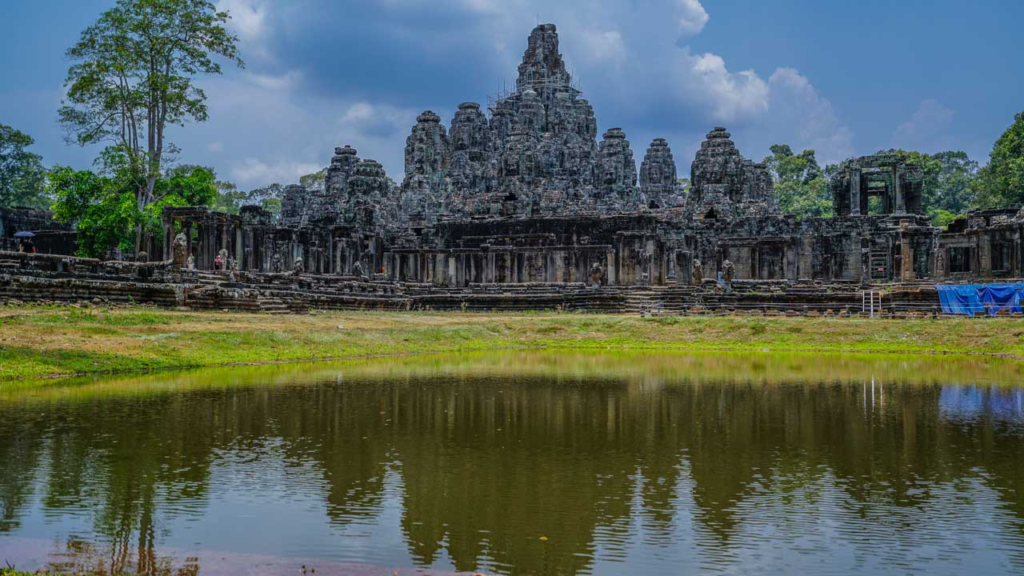
At the geographical and spiritual heart of Angkor Thom stands the Bayon, and nothing in the ancient world quite prepares you for your first sight of it. Rising from a broad base in tiered stone galleries, the Bayon culminates in 54 towers — each carved with four serene, enigmatic faces gazing toward the four compass points. In total, 216 faces watch over the city and its people. The effect is simultaneously eerie and deeply moving.
Built by Jayavarman VII in the late twelfth century, the Bayon blends Mahayana Buddhist devotion with Khmer imperial cosmology. The faces are widely believed to represent Avalokiteshvara, the Bodhisattva of Compassion, though some scholars suggest they also carry the likeness of the king himself — a divine-mortal fusion that was central to Khmer political theology.
The lower galleries are lined with extraordinary bas-relief panels stretching nearly 1.2 kilometers in total. These carvings are unusually intimate for Khmer art — they depict not only celestial battles and religious narratives but scenes of ordinary Khmer life: a market, a cockfight, a woman giving birth, soldiers marching to war. Walking these corridors is less like reading a history textbook and more like moving through a visual novel of an entire civilization.
The best time to visit is at sunrise, when the pale golden light moves across the stone faces, and the crowds are still thin. Arrive no later than 6:00 AM. In the afternoon, softer light returns around 4:00 PM, and the temple empties of tour groups.
Insider tip: Look for the painted traces still visible in some sheltered gallery alcoves — the Bayon was once brightly painted, and faint red and gold pigments remain on protected surfaces.
The South Gate & Causeway — The Grand Entrance
Before you even enter Angkor Thom, the South Gate delivers one of the most spectacular architectural approaches in the world. A stone causeway 100 meters long bridges the moat, flanked on both sides by 54 stone figures on each bank — gods and demons engaged in the mythological Churning of the Sea of Milk, their muscular arms clutching the body of the great naga serpent Vasuki.
The gate itself rises 23 meters, crowned by four immense stone faces that seem to hover above the jungle canopy. The scale is genuinely shocking up close — you feel miniaturized walking beneath the gate’s central vault, under those faces that have watched every ruler, pilgrim, and conqueror who entered the Great City for eight centuries.
The South Gate is also the busiest and most photographed, but early-morning visits still offer moments of quiet revelation, especially from the causeway, where you can observe the serpent-bearers in detail — their expressions ranging from serene concentration to fierce determination, each figure subtly differentiated despite the collective grandeur of the tableau.
Insider tip: Rent a bicycle or tuk-tuk and approach via the Victory Gate on the east side for a far quieter, less-photographed experience of the walls and a very different atmosphere.
The Elephant Terrace — A Royal Processional Stage
Running 300 meters along the eastern edge of the Royal Palace enclosure, the Elephant Terrace is one of the most extraordinary works of Khmer stone carving anywhere in the Angkor complex. The terrace served as a public viewing platform from which the king and royal court would observe processions, ceremonies, military parades, and royal elephant formations below in the great open square known as the Central Square of Angkor Thom.
The terrace walls are carved in elaborate relief: elephants rendered at nearly life-size scale march in long processions, their trunks curving to grasp lotus flowers or raise in royal salute. Garuda — the great mythological bird of Hindu cosmology — appears as well, serving as a caryatid figure supporting the terrace platforms. The carvings are so dense and so well-preserved that walking the full length of the terrace is an absorbing experience in itself, like reading a continuous stone scroll.
In the middle of the terrace, a projecting platform with five tiers rises higher than the rest — this is where the king’s throne once stood while he presided over events in the square. Standing here, you can look out over the same expanse the Khmer monarch surveyed nearly a millennium ago.
Insider tip: Walk around to the back of the terrace — the interior walls contain extraordinary carvings, including a magnificent row of three-headed elephants that most visitors entirely miss.
Ta Prohm — The Temple the Jungle Reclaimed (Tomb Raider Temple)
Just outside the formal boundaries of Angkor Thom, but essential to any visit, is Ta Prohm, forever immortalized as the “Tomb Raider Temple” after serving as a location for the 2001 Angelina Jolie film Lara Croft: Tomb Raider. The French conservators who began restoring Angkor in the early twentieth century made a deliberate decision to leave Ta Prohm largely as they found it, allowing the jungle’s reclamation to remain visible as a testament to centuries of abandonment.
The result is one of the most breathtakingly atmospheric places in Southeast Asia. Enormous silk-cotton trees and strangler figs have wrapped their root systems around the temple’s galleries, towers, and walls in an organic embrace that is simultaneously destructive and hauntingly beautiful. Roots thick as human torsos flow down across carved lintels. Towers lean at impossible angles, held in place partly by root systems. Moss carpets every stone surface in deep green.
Originally built by Jayavarman VII as a monastery and university in 1186 CE, Ta Prohm once housed more than 12,000 people, including monks, teachers, and servants. Its inscriptions record extraordinary wealth: nearly 80,000 kilograms of gold vessels, silk, and gems. Today, what remains is stone and root and the memory of a world lost to time.
Insider tip: The famous tree-root-over-doorway images fill up quickly with photographers. Arrive at the eastern entrance at 7:00 AM and walk toward the western exit — you’ll hit the iconic spots while most visitors are still at Angkor Wat.
The Terrace of the Leper King — Myth and Mystery
Adjacent to the Elephant Terrace stands a smaller but deeply intriguing platform: the Terrace of the Leper King. Its name derives from a seated stone statue found at the top — a nude figure without genitalia, which, according to local tradition, depicted a Khmer king afflicted with leprosy, though scholars believe the figure is actually Yama, the god of death and the underworld.
What makes this terrace exceptional is its hidden inner wall, accessible via a narrow trench excavated beside the outer face. Walking this inner passage is an almost claustrophobic experience as towering carved panels of apsaras, mythological beings, and underwater creatures press in on both sides — untouched for centuries and still covered with finely detailed carvings of remarkable preservation. It is perhaps the best-preserved bas-relief in all of Angkor.
Insider tip: The inner trench entrance is easy to miss — look for the opening on the terrace’s north side and ask your guide if needed. Most visitors walk straight past it.
Phimeanakas — The Celestial Palace
Deep within the Royal Palace enclosure of Angkor Thom, largely hidden among trees and often overlooked, stands Phimeanakas — the Celestial Palace. Built in the style of a Khmer temple-mountain, it rises in three diminishing tiers to a central sanctuary at the top, its sandstone walls still bearing traces of the gold sheeting that once covered the entire structure.
According to the accounts of the Chinese diplomat Zhou Daguan, who visited Angkor in 1296 and wrote the only surviving eyewitness account of the city in its final flourishing, the king slept each night in Phimeanakas’s tower to commune with a naga spirit who took the form of a woman. Only after this nightly ritual could he return to his human queen. The story captures something essential about the relationship between divine and mortal authority in Khmer culture — a place where the palace was simultaneously a home and a cosmic axis.
Insider tip: The laterite enclosure wall of the Royal Palace compound, stretching 250 meters on each side, is largely unexplored by tourists and offers a serene walk through shaded pathways.
Baphuon Temple — The World’s Largest Jigsaw Puzzle
Baphuon is one of Angkor’s most remarkable architectural achievements and its most extraordinary conservation story. Built in the mid-eleventh century as a state temple dedicated to Shiva, Baphuon is a massive temple-mountain whose five-tiered sandstone tower once stood nearly 43 meters tall. By the twentieth century, it had largely collapsed, and French conservators spent decades documenting and dismantling 300,000 individual stones, each numbered and cataloged, with plans to reconstruct the entire structure.
Then the Khmer Rouge came. The civil war not only halted the project but also destroyed the records. When conservators returned after the war, they faced a field of 300,000 numbered stones with no map. It took decades more work to reconstruct what had been lost — and some of it may never be fully recovered. Baphuon was finally reopened in 2011 after a restoration effort spanning fifty years. It stands today as an architectural triumph, a testament to both Khmer ambition and modern dedication.
A long elevated causeway 200 meters long connects the temple to its eastern entrance gate — one of the most graceful approaches in all of Angkor — and at the rear of the temple, a massive reclining Buddha figure has been carved into the western face, dating from the fifteenth century when the temple was converted to Buddhist use.
Insider tip: Climb to the third level for exceptional views across the Angkor Thom complex and, on clear days, a glimpse of Angkor Wat’s towers in the distance.
Unique Experiences & Activities
Sunrise at Bayon
While most visitors chase sunrise at Angkor Wat, the true connoisseurs of Angkor gather at Bayon instead. As the first light of dawn touches the stone faces from behind, they seem to animate — each face catching the glow differently according to its angle, some in bright warmth, some still in shadow. The effect is genuinely otherworldly, a light show that no photographer or filmmaker has ever quite captured in full. Be there no later than 5:45 AM, and bring patience and a wide-angle lens.
Sunrise at Ta Prohm
The Ta Prohm experience changes dramatically in the early-morning mist. Before 7:00 AM in the cool-season months (November–February), wisps of mist curl through the root-wrapped corridors, softening the light and amplifying the temple’s sense of mystery. At this hour, the site belongs almost entirely to you and the birds.
Cycling the Outer Circuit
Renting a bicycle and cycling Angkor Thom’s outer perimeter road is a completely different way to engage with the complex. The perimeter wall stretches nine kilometers, and the road that runs beside it threads through jungle, past local villages and smaller, rarely visited shrines. This is Angkor at a human scale — quiet, shaded, and completely free of crowds in most sections.
Discovering Bas-Relief Stories at Bayon
Hire a specialized Bayon bas-relief guide — not a general temple guide — for a deep dive into the lower gallery carvings. A knowledgeable guide can reveal the extraordinary breadth of the narrative: the naval battle between the Khmers and the Chams on the Tonle Sap Lake, the army of foot soldiers and war elephants, the market scenes, the festival processions. Two hours in these galleries with expert interpretation is one of the most intellectually rewarding experiences in Southeast Asia.
Monk Blessing Ceremony
Some of Angkor Thom’s smaller temples and shrines are active Buddhist places of worship. Approaching respectfully, removing footwear, and receiving a blessing from resident monks — a knotted white thread tied to your wrist with a murmured prayer — connects you to the living spiritual tradition that the Khmer Empire ultimately became. It is a gesture, not a performance, and it matters.
Photography at the South Gate at Blue Hour
Fifteen minutes before sunrise, when the sky softens to a deep indigo and the moat reflects the gate’s towers in perfect stillness, is the most breathtaking lighting window for photography at the South Gate. A tripod is essential; a reflection shot from the moat’s edge produces images of unusual power.
Hidden Gems of Angkor Thom
Prasat Suor Prat — The Towers of the Cord Dancers
Lining the eastern side of the Central Square, twelve identical sandstone towers stand at regular intervals — elegant, slender, largely ignored by the visitors who rush past them to reach the Bayon. Known as the Towers of the Cord Dancers, their exact function remains debated: some scholars believe they housed sacred images used in festivals, others that tightrope performers danced between them during royal celebrations. Whatever their purpose, the towers’ clean lines and quiet presence reward anyone who pauses. They are usually entirely empty of other visitors.
The Inner Wall of the Terrace of the Leper King
Already mentioned, but worth emphasizing: the hidden inner passage of the Terrace of the Leper King, accessible via a narrow excavated trench, contains arguably the finest and most intimate bas-relief carvings in all of Angkor. You walk through a narrow canyon of carved stone no wider than your shoulders. Practically nobody comes here.
Preah Palilay — The Forest Buddhist Temple
A short walk north of the Royal Palace enclosure, through dense trees that shade the path into a green tunnel, lies Preah Palilay — a compact Buddhist temple now wrapped in the roots of a massive silk-cotton tree. Unlike Ta Prohm, Preah Palilay receives almost no visitors. On a quiet morning, you may have the entire site entirely to yourself, accompanied only by the sound of wind in the canopy above and the distant calls of hornbills.
Tep Pranam — The Open-Air Buddha
A short distance from Preah Palilay, a large seated Buddha figure assembled from salvaged Angkorean stones sits in an open-air shrine tended by local worshippers. Monks from a nearby monastery visit regularly, and offerings of flowers and incense smoke perfume the air. It is a place of genuine living devotion, tucked into a corner of the complex that most itineraries entirely omit.
Suggested Itineraries
Angkor Wat Bike Tour (Full-Day Adventure)
Duration: ~8 Hours
Style: Active | Cultural | Local Experience
Itinerary (Simplified):
- sunrise at Angkor Wat
- Ride through Angkor jungle trails
- Discover Angkor Thom & Bayon Temple
- Explore royal sites & hidden temples
- Local lunch experience
- Visit Ta Prohm (jungle temple)
Best for travelers who want the full Angkor experience
Best Time to Visit
- Nov – Feb: Cool and dry. Peak season. Ideal conditions. Busy crowds at major sites. Best for photography and comfort.
- Mar – May: Hot and increasingly humid. Pre-monsoon heat can exceed 38°C. Fewer crowds. Early mornings essential.
- Jun – Sep: Wet season. Afternoon rains, lush green jungle, dramatic skies. Fewer tourists. Flooding possible but manageable.
- Oct: Transition month. Rain is still possible but decreasing. Tonle Sap at its highest level. Waterlilies in moats. Atmospheric beauty.
The sweet spot for most visitors is November through early February: temperatures hover around 26–30°C, humidity is manageable, and the early-morning and late-afternoon light is extraordinary. December and January see the highest visitor numbers — arrive at major temples at least 30 minutes before official opening time to secure the best positions.
How to Get There
Siem Reap International Airport offers direct flights to Bangkok, Singapore, Kuala Lumpur, Hong Kong, and Guangzhou, with connections from most major regional hubs. The journey from Siem Reap town center to the Angkor Archaeological Park ticket gate takes approximately 10–15 minutes by tuk-tuk.
From the ticket gate, Angkor Thom’s South Gate is a further five minutes by vehicle. Tuk-tuks are the standard and most enjoyable mode of transport — hire a driver for a full or half day (negotiate in advance, expect USD $12–18 for a full-day small circuit). Bicycles can be rented near the ticket gate for USD $2–4 and are excellent for riding along the outer perimeter road and visiting less-visited temples.
Practical Travel Tips
- Tickets: A 1-day pass costs USD $37, a 3-day pass USD $62, and a 7-day pass USD $72. Tickets must be purchased at the official ticket gate — buy before dawn if planning a sunrise visit. Tickets are non-transferable, and photo ID is checked.
- Dress Code: Shoulders and knees must be covered at all temple sites. Light, loose-fitting natural fabrics are ideal. A light scarf doubles as a shawl and sun protection. Most temples involve significant walking on uneven stone — good closed-toe shoes are essential.
- Hydration: Carry at least 1.5 liters of water at all times. Dehydration in the heat and humidity sneaks up quickly. Electrolyte sachets are a worthwhile addition.
- Timing: The temples are most bearable before 10:00 AM and after 3:30 PM. The midday hours (11:00 AM – 2:00 PM) are hot, crowded at major sites, and photographically flat. Use this time for lunch and rest.
- Photography: Tripods require a separate permit from the ticket office. Drone flight is prohibited throughout the park. Flash photography damages the ancient pigments and is banned inside all galleries.
- Cultural Respect: Do not touch bas-reliefs. Do not climb on structures where prohibited. Do not turn your back on Buddha images for photos. If monks are present in worship, give them space and silence.
Who Is This Destination For?
- History & Culture Lovers: The most densely rewarding experience imaginable — every surface, every gateway, every inscription is a document of Khmer civilization at its peak.
- Photographers: The play of light on stone faces, jungle roots over carved lintels, and reflections in moats offer world-class shooting opportunities at every hour.
- Spiritual Seekers: The temples remain active, sacred spaces. The atmosphere of devotion, incense, and centuries of prayer is palpable and moving even for non-religious visitors.
- Solo Travelers: The complex is extremely safe, well-marked, and deeply rewarding to explore at your own pace with no schedule to keep.
- First-Time Visitors to Asia: Angkor offers one of the most accessible introductions to Southeast Asian history, with strong infrastructure, English-speaking guides, and clear signage.
- Couples: A sunrise at Bayon together, a quiet moment in a jungle temple — few destinations offer this caliber of shared, once-in-a-lifetime experiences.
Sustainability & Responsible Travel
Angkor receives millions of visitors annually, and the pressure this places on both the monuments and the surrounding communities is significant. Traveling responsibly here means making small choices that collectively matter.
- Stay at locally owned guesthouses and hotels in Siem Reap rather than international chain resorts — your dollars circulate more directly into the community.
- Hire a licensed Khmer guide rather than relying solely on downloaded apps. Guides are trained professionals who depend on tourism income, and their interpretation will exponentially deepen your experience.
- Do not purchase archaeological artifacts offered by vendors inside or outside the park. The trade in looted Khmer antiquities has devastated the region’s heritage for decades.
- Follow all conservation guidelines — do not touch bas-reliefs, do not remove stones or fragments, and report any damage or vandalism you observe to park staff.
- Choose the 3-day or 7-day pass rather than the 1-day option. The longer you stay, the more you spend in Siem Reap’s local economy, and the more deeply you can engage with the site without rushing.
- Carry a reusable water bottle and refuse single-use plastic bags at market stalls — plastic waste in and around the park is a serious environmental concern.
Frequently Asked Questions
How much time should I allocate to Angkor Thom alone?
At minimum, a full morning (5:30 AM to noon) devoted solely to Angkor Thom — the Bayon, Baphuon, the terraces, and the gates — will feel satisfying but not exhaustive. If you wish to also include Ta Prohm, the hidden temples, and the outer perimeter, plan for a full day. A 3-day pass gives you the freedom to return and revisit without pressure, which transforms the experience.
Is Angkor Thom suitable for children?
Yes, with some planning. Children who are engaged with adventure and exploration tend to love the jungle atmosphere, the giant stone faces, and the root-wrapped corridors of Ta Prohm in particular. Heat is the primary concern — keep visits to the cool morning hours, carry significant water, and plan a proper midday rest. Children under 12 enter free with a ticketed adult.
What is the difference between Angkor Thom and Angkor Wat?
Angkor Wat is a single magnificent temple complex — the largest religious monument in the world — built in the twelfth century as a dedication to Vishnu. Angkor Thom is an entire ancient city, built slightly later under a different king, and it encloses multiple temple complexes, a royal palace, residences, and public spaces within a nine-kilometer walled perimeter. Angkor Wat sits just outside the southern wall of Angkor Thom, and the two are entirely separate, though part of the same archaeological park.
Can I visit without a guide?
Yes — the major sites are clearly accessible, and many visitors explore independently, using maps, apps, or audio guides. However, for the Bayon’s bas-reliefs in particular, a knowledgeable guide transforms what would be interesting stone carvings into a deeply meaningful narrative experience. Many visitors who visit solo the first time return specifically to hire an expert guide the second time, describing it as an entirely different place with interpretation.
Is there food and water available inside the park?
Yes. Small vendor stalls selling water, fresh coconuts, snacks, and simple Khmer dishes are positioned near most major temples. Prices are fair. There are also proper restaurants near the main ticket gate and adjacent to Angkor Wat. That said, carrying your own sealed water is strongly recommended both for hygiene and to reduce plastic waste.
How do I get the most iconic Bayon photograph?
Arrive at Bayon before sunrise. Climb immediately to the upper level and position yourself facing east — the rising sun will illuminate the faces from behind you. A wide-angle lens (between 16mm and 24mm full-frame equivalent) captures several faces simultaneously. For the most intimate portrait-style shots of individual faces, a moderate telephoto lens (85–135mm) beautifully isolates the features in the soft early light. The most photogenic face grouping, famously reproduced in countless books and documentaries, is found on the tower at the very center of the upper terrace.